My research paper is most likely going to be an expository research paper. I say this because I will be putting forth specific information, as opposed to bringing up an argument, or trying to persuade the reader to believe what I am writing about. There really is no right or wrong idea about my paper, because it is simply straight up facts about the social, moral, and political philosophies of Martin Luther King Jr.
One might take the information about Dr. King’s beliefs as being right or wrong, but the facts that I will be presenting come straight from our country’s history, and for the most part can not be challenged. If i were to be writing a persuasive research paper, I might try to get the reader to believe in what Martin Luther King Jr. believed in. I may argue that segregation and discrimination are wrong, and should not have gone on as long as they did without a law against them.
Monday, March 5, 2007

Source # 5
My fifth source is a book titled Revolution of Conscience by Greg Moses. I found a certain section in the book useful, because it discusses events in Kings life both at a young age and an adult.
His family, church, and school were the most important thing in King’s life as a child. He was quoted saying: “It is quite easy for me to think of a God of love mainly because I grew up in a family where love was central and where lovely relationships were ever present. It is quite easy for me to think of the universe as basically friendly mainly because of my uplifting hereditary and environmental circumstances. It is quite easy for me to lean toward optimism than pessimism about human nature mainly because of my childhood experiences”.
There were also several instances that occurred when King was young that influenced his way of thinking in a negative way. For example starting at the age of five, King was influenced by witnessing soup lines during the Great Depression. At the age of six he felt what it was like to be subjected to racism. The father of one of his white friends banned his son from playing with King because he was a child of color. Despite these negative events in King’s young life, when he first entered public school, he proved to be an excellent young student
Moses, Greg. Revolution of Conscience. New York: The Guilford Press, 1997.
His family, church, and school were the most important thing in King’s life as a child. He was quoted saying: “It is quite easy for me to think of a God of love mainly because I grew up in a family where love was central and where lovely relationships were ever present. It is quite easy for me to think of the universe as basically friendly mainly because of my uplifting hereditary and environmental circumstances. It is quite easy for me to lean toward optimism than pessimism about human nature mainly because of my childhood experiences”.
There were also several instances that occurred when King was young that influenced his way of thinking in a negative way. For example starting at the age of five, King was influenced by witnessing soup lines during the Great Depression. At the age of six he felt what it was like to be subjected to racism. The father of one of his white friends banned his son from playing with King because he was a child of color. Despite these negative events in King’s young life, when he first entered public school, he proved to be an excellent young student
Moses, Greg. Revolution of Conscience. New York: The Guilford Press, 1997.
Wednesday, February 28, 2007
Famous Words (source # 4)

During research, I came across a cite that was loaded with quotes from Martin Luther King Jr. They are all pretty inspirational, and uplifting. I thought I would use this blog to share a few of the ones I thought were most interesting. They also give you a sense of how Dr. King spoke to his audiences while he was still alive.
"Like an unchecked cancer, hate corrodes the personality and eats away its vital unity. Hate destroys a man's sense of values and his objectivity. It causes him to describe the beautiful as ugly and the ugly as beautiful, and to confuse the true with the false and the false with the true."-MLK
"The good neighbor looks beyond the external accidents and discerns those inner qualities that make all men human and, therefore, brothers." - MLK 'Strength to Love,' 1963
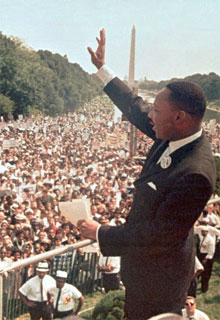
"Now, I say to you today my friends, even though we face the difficulties of today and tomorrow, I still have a dream. It is a dream deeply rooted in the American dream. I have a dream that one day this nation will rise up and live out the true meaning of its creed: - 'We hold these truths to be self-evident, that all men are created equal." - MLK Speech at Civil Rights March on Washington, August 28, 1963
"The ultimate measure of a man is not where he stands in moments of comfort and convenience, but where he stands at times of challenge and controversy."- MLK Strength to Love, 1963
"Quotations by Author." The Quotations Page. 17 Feb. 2007 http://www.quotationspage.com/quotes/Martin_Luther_King_Jr./.
Vietnam War

While researching about MLK's political philosophies, I found some information about his stand on the Vietnam War. First, he felt that the war took away from the poverty program that had been started in the U.S. It not only took attention away from the issue but also funding. He thought of the war as an enemy to the poor. Before the war, it looked as if there was going to be a solution to poverty, but as Vietnam began to buildup, that hope faded in the background. King knew that as long as our nation’s government was going to participate in the war, they would not give extra funds or attention to the poverty problem in their own backyard (Beyond p.9). Also, we were sending troops over to Vietnam, both black and white, to help guarentee liberties in Southeast Asia, which they had not found in southwest Georgia and East Harlem here at home in the U.S.. The nation was seeing pictures of young white men and young black men dying together for a nation that was unable to seat them together in school. The irony of the situation seemed to be overwhelming. It didn’t make much sense as to why we were sending blacks and whites to fight for liberty in a country so far away, when they didn’t have the same liberties back in their home country (Beyond p.10) I agree with much of what King says, because I didn't thing that it made much sense to participate in a war thousands of miles away, before we could solve the problems within our own country.
Works Cited
Works Cited

Saturday, February 17, 2007
Peers Helping Peers
During Tuesday's class we got together and shared our papers. We are all working on different subjects and we all have somewhat different writing styles so I found it to be pretty helpful to get some insite on my paper.
I got a lot of help with changing up a few sentences or phrases that sounded awkward to the reader. Along with that my peers made a few grammer corrections such as commas and incorrect spelling. I think it is always helpful to have a new set of eyes go over your paper. They always seem to catch the mistakes that you miss from reading the paper too many times in your own head.
I basically gave the same kind of corrections to my peers as well. Again grammer and spelling errors, along with a few mechanical things. There was some repetition in one paper, and citation errors in the others.
Overall I thought that meeting as a group and going over our papers was helpful. I got to tell them what to look for and what I needed help with, and they delivered.
I got a lot of help with changing up a few sentences or phrases that sounded awkward to the reader. Along with that my peers made a few grammer corrections such as commas and incorrect spelling. I think it is always helpful to have a new set of eyes go over your paper. They always seem to catch the mistakes that you miss from reading the paper too many times in your own head.
I basically gave the same kind of corrections to my peers as well. Again grammer and spelling errors, along with a few mechanical things. There was some repetition in one paper, and citation errors in the others.
Overall I thought that meeting as a group and going over our papers was helpful. I got to tell them what to look for and what I needed help with, and they delivered.
Saturday, February 10, 2007
Looking to Gandhi (source # 3)

I found out in my one of my other sources that Martin Luther King Jr. took his ideals from his strong Christian background, and his operational ways from Gandhi. That cued me in on finding more about Gandhi and his ideas in order to understand how MLK operated.
Dr. King was heavily influenced by Dr. Johnson, a famous educator, while he attended Crozer Theological Seminary. Dr. Johnson, having recently returned from India, was full of admiration for Gandhi. Gandhi was the subject of an address he made, which Dr. King attended his senior year. Dr. Johnson stressed Gandhi's demonstration of the redemptive power of love as an instrument of nonviolent social reform. King then pursued Gandhi's writings about ahimsa and satyagraha.
King then used what he learned and spoke of love as the answer to overcome social inequality issues. For example, when King's home was bombed in 1956, he urged the crowd to not resist police because violence must be met with nonviolence. He calmed the angry crowd down, and it was evident that the words of Gandhi were now embedded into his mind, and his life.
Power, Paul F. The Meanings of Gandhi. First ed. The UP of Hawaii, 1971. 158-163
Dr. King was heavily influenced by Dr. Johnson, a famous educator, while he attended Crozer Theological Seminary. Dr. Johnson, having recently returned from India, was full of admiration for Gandhi. Gandhi was the subject of an address he made, which Dr. King attended his senior year. Dr. Johnson stressed Gandhi's demonstration of the redemptive power of love as an instrument of nonviolent social reform. King then pursued Gandhi's writings about ahimsa and satyagraha.
King then used what he learned and spoke of love as the answer to overcome social inequality issues. For example, when King's home was bombed in 1956, he urged the crowd to not resist police because violence must be met with nonviolence. He calmed the angry crowd down, and it was evident that the words of Gandhi were now embedded into his mind, and his life.
Power, Paul F. The Meanings of Gandhi. First ed. The UP of Hawaii, 1971. 158-163
Tuesday, February 6, 2007
So Far...
Besides trying to keep track of how many blogs are due at this point in the semester, everything is going pretty well. As one could assume, there is plenty of information out there about Martin Luther King Jr., so I'm not having trouble finding any sources. I am, however, somewhat struggling on how to sift through these sources to find qualifying information for my paper. I think that once I make an outline of how I want my eight + pages to look, I'll be able to find the key information that I need.
I also think that right now I just have a jumble off things for this paper all scattered around, whether it be on my desk or in cyber space. Once I get organized and can really see my paper coming together I wont stress so much over it.
I know that there is plenty of information all over the place about Martin Luther King, but im worried that my paper is going to turn into a biography instead of just about the points I want to cover. Those points include his social, moral, and political philosophies. I know I can get away from MLK by talking about where he gets his ideals from which is his strong Christian background. I may be able to discuss that topic and get a few pages out of that and a few pages out of Gandhi which is where he got his operational ideas from. Im just hoping I can make this paper turn out the way I planned for.
I also think that right now I just have a jumble off things for this paper all scattered around, whether it be on my desk or in cyber space. Once I get organized and can really see my paper coming together I wont stress so much over it.
I know that there is plenty of information all over the place about Martin Luther King, but im worried that my paper is going to turn into a biography instead of just about the points I want to cover. Those points include his social, moral, and political philosophies. I know I can get away from MLK by talking about where he gets his ideals from which is his strong Christian background. I may be able to discuss that topic and get a few pages out of that and a few pages out of Gandhi which is where he got his operational ideas from. Im just hoping I can make this paper turn out the way I planned for.
Subscribe to:
Posts (Atom)